|
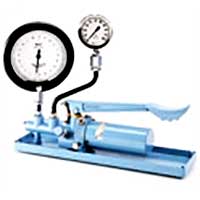
Ashcroft® engineers have developed a new generation of
test gauges to meet the exacting needs of instrument engineers and
quality specialists.
Ashcroft® Test Gauge Selection
Pressure Ranges: For process applications, select
an Ashcroft® test gauge with a full scale pressure range of
approximately twice the normal operating pressure. The maximum
operating pressure should not normally exceed 75% of the full range.
For laboratory applications, where cycling is less frequent, the
range of the test gauge may be the same as that of the instrument
under test.
Operating Conditions: To ensure long life and
accurate readings, test gauges should not be exposed to process or
ambient temperatures over 150°F. This is especially true of gauges
with liquid filled cases due to thermal expansion of the case fill
fluid. Long term exposure to temperatures in excess of 150°F may
cause discoloration of dials and fill fluids, as well as hardening
of elastomeric case seals and possible fill leakage. Soft soldered,
silver brazed and welded pressure joints are rated at 250°F maximum,
450°F maximum and 750°F maximum respectively. Plastic gauge cases,
including phenolic should not be exposed to temperatures in excess
of 250°F. Accuracy of temperature compensated Type test 1082 gauges
will be affected by approximately 0.005% per degree F and accuracy
of all other test gauges will be affected by approximately 0.015%
per degree F.
Cases: Ashcroft® offers six different case styles
and three different materials – aluminum alloy, fiberglass
reinforced polypropylene, and phenolic. Two types are offered, open
and solid front. The open front Type 1084 case is constructed with
the dial between the bourdon tube and the window, with a pressure
relief opening between the socket and the case. The solid front
cases supplied on all other test gauges provide increased safety
with a solid wall between the bourdon tube and the window. The
entire rear of the gauge is covered with a stainless steel pressure
relief back. Should the Bourdon tube fail due to overpressure,
corrosion or fatigue, the wall directs pressure buildup through the
rear of the case and away from the dial and the window.
Bourdon Tube Pressure Elements: Available for a
wide variety of media applications; materials include phosphor
bronze and K-Monel®.
Movement: All Ashcroft® test gauges 41⁄2˝ size and
larger feature a rotary geared movement, the most efficient and
positive method of transmitting mechanical motion. Moving parts are
designed and protected to reduce friction and wear. All movements
are ultrasonically cleaned and lubricated to guarantee smooth operationand to resist wear associated with high vibration and/or
pulsation. Span, linearity, and zero adjustments are easily made to
assure continued accuracy of all Ashcroft® test gauges.
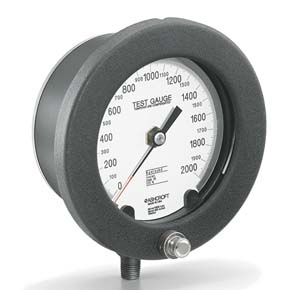
Dials: Aluminum dials have highly legible black
markings on a white background. Each test gauge dial has a mirror
band which eliminates parallax errors when the pointer and its
reflection are aligned. External adjustable dial available in
standard case style 1082(*)S.
Pointers: Balanced knife-edge tip pointers,
supplied with all test gauges, allow precise and easy readings. All
are lightweight to maintain a high standard of accuracy. Ashcroft®
Type 1082 and 1084 pointers include a red tip for enhanced
readability.
Windows: The standard window for Type 1082 test
gauge is glass. Non-glare glass is optional. Acrylic windows, also
optional, are more resistant to impact breakage than glass windows.
Safety glass, also optional, will not fracture into many pieces as
will ordinary glass. Window for Ashcroft® Type 1084 is polycarbonate.
Rings: The ring, which retains the window, is
threaded, bayonet (cam) or hinged, depending upon case type. All
Ashcroft® Type 1082 windows have a gasket to protect the internal
mechanism from outside environments.
To start, please
select a basic type of Ashcroft® Test Instrument
or contact us for help: |